Home / Research
How the guide was researched
Fallout Ready contains no advice of our own invention. It collects what emergency planners and scientists have already published and arranges it by where you are when it happens. This page shows the sources, how we weigh them, and where the guide stops.
The short version
- 14 references, all public, listed in the book's Appendix B and below.
- Every instruction traces to a source. Source codes such as [FEMA-PG] appear in the text, and each chapter ends with its own source list.
- Current official guidance decides. Where older or independent material disagrees with it, the guide follows the official line.
- Sources were checked in November 2026, because official pages change.
Why read it rather than the sources themselves
You can read the sources yourself, and we link them so that you can. The trouble is practical. The official advice is spread across a 200-page planning document written for emergency managers, several agency web pages, a laboratory technical report and a 1977 reference book. None of them is organised around the question a person actually has: I am in my car, or my office, or on the street. What do I do now?
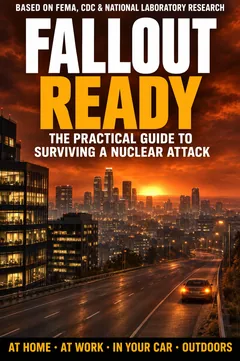
The guide's contribution is the arrangement. Each of the four scenario chapters (home, work, driving, outside) follows the same clock: the first 60 seconds, the first 10 minutes, the first 24 hours. Each ends with the common mistakes and a short list of do-nots. Decontamination, living in shelter for up to two weeks, leaving, and a stockpile list sized for a household follow. It is 61 pages, meant to be read once and kept.
How sources are ranked
1. Official guidance: this decides the advice
- FEMA, Planning Guidance for Response to a Nuclear Detonation, 3rd edition (2022): damage and fallout zones, fallout timing, how long to shelter.
- Ready.gov, Radiation Emergencies, the Nuclear Detonation Safety flyer (2023) and Build a Kit: the public protective actions and supplies.
- CDC, What to Do: Get Inside, How to Self-Decontaminate (2024) and Potassium Iodide (KI), plus its carbon monoxide guidance.
- EPA, Emergency Disinfection of Drinking Water.
2. Technical references: these supply the numbers
- Lawrence Livermore National Laboratory, Key Response Planning Factors for the Aftermath of Nuclear Terrorism, LLNL-TR-410067 (2009): how much protection a car, a wooden house, a basement or a large building gives.
- Glasstone and Dolan, The Effects of Nuclear Weapons, 3rd edition (US Department of Defense and Department of Energy, 1977), chapter 9: how fast fallout radiation decays, the "7:10 rule".
- US Department of Homeland Security, Center for Domestic Preparedness, The 7:10 Rule of Thumb: confirms that rule.
3. Practical detail only
- American Red Cross, Survival Kit Supplies: how long a home supply should last.
- Kearny, Nuclear War Survival Skills (Oak Ridge National Laboratory, 1979, updated 1987): used only for practical techniques such as shielding, water and sanitation, and never where it conflicts with current official guidance.
The accuracy rules
- No source, no instruction. If a step cannot be traced to a research note, it is cut or plainly labelled a practical tip.
- When sources disagree, current official guidance wins. Two examples: potassium iodide is to be taken only on official instruction, and the guide says to stay sheltered for at least 24 hours even though laboratory modelling suggests earlier moves can make sense in some cases.
- No predictions for particular cities, and no blast maps.
- No medical dosing of our own.
- Sources are re-checked before each edition. Official pages are revised: CDC, for example, removed a note from its decontamination page in 2024. Changes like that are what the re-check looks for.
What the guide is not
- Not official. No government agency is affiliated with it or endorses it. In a real emergency, your own authorities' instructions come first.
- Not written by a named expert. It was researched and drafted with the assistance of AI tools and checked against the sources above. That is exactly why the source codes are in the text: so that any instruction can be checked against the original.
- Not a guarantee. No guide can promise survival. It sets out the actions planners and scientists consider most likely to reduce injury and radiation exposure for people outside the immediate area of destruction.
- American in its details. The physics is the same everywhere, but units and named services are US ones. Appendix B points readers in the UK, Canada, Australia and the EU to their own authorities.
- About one event. It covers a nuclear weapon detonation, not a power-plant accident or a "dirty bomb".
Check it yourself
Chapter 1 is free to read in full, with its source codes. The free guides on this site each list their sources too. If you find something that does not match its source, tell us at contact@survivenuclear.com and we will correct it.